Why Ancient Ur Was the Perfect Place to Begin
Every story needs a doorway.
For Mathatar, that doorway is ancient Ur.
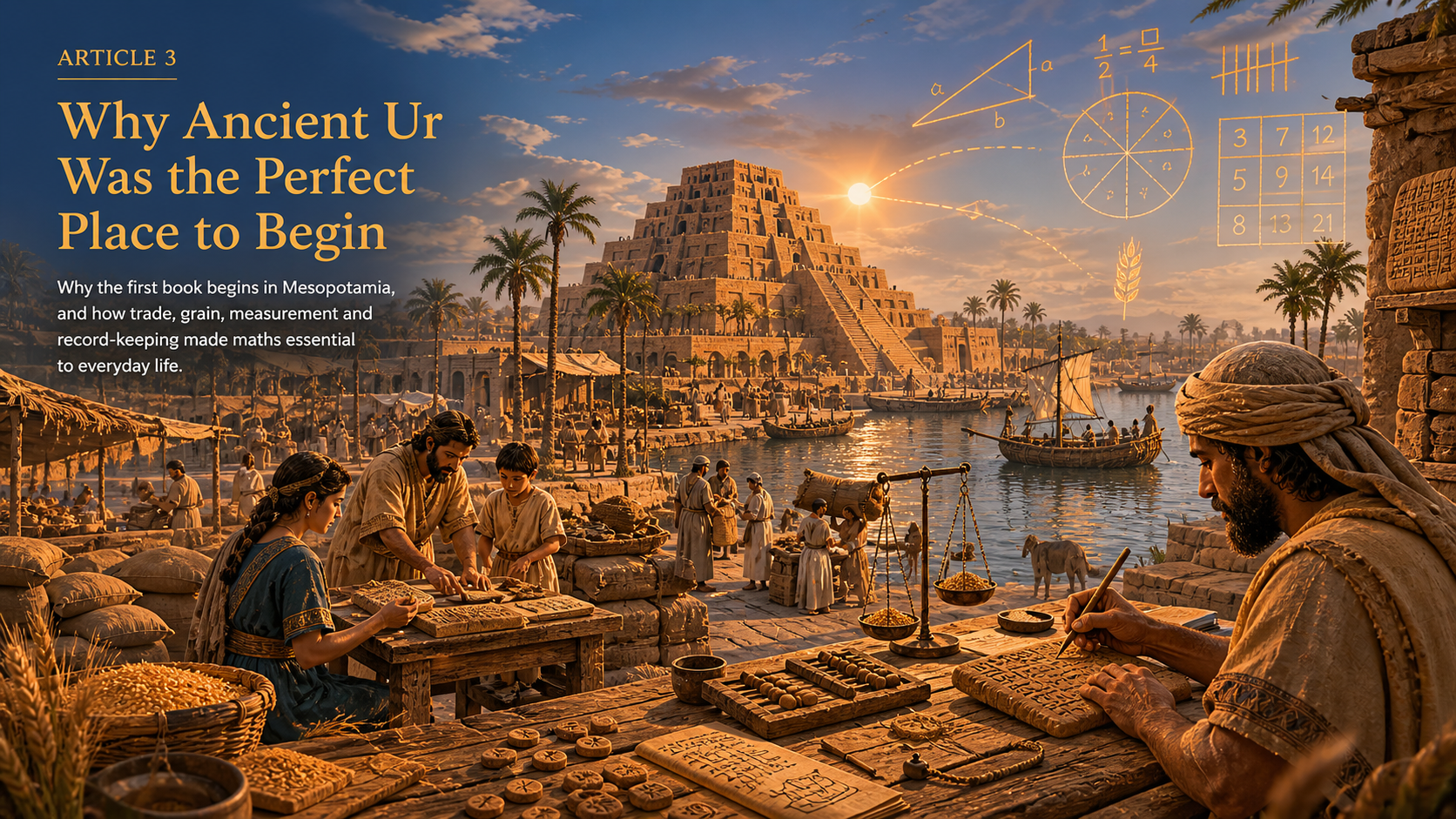
Ur, where sexagesimal maths was born.
Not because Ur is simply old.
Not because it gives the story sand, temples, markets and dramatic skies.
Not because ancient cities automatically feel mysterious.
Ur was the perfect place to begin because it was a world where maths mattered.
Not as a school subject.
Not as something separate from life.
But as part of ordinary survival.
Grain had to be counted.
Land had to be measured.
Workers had to be paid.
Goods had to be recorded.
Buildings had to stand.
Time, trade, food, labour and trust all depended on people being able to keep track of things.
That made Ur an ideal first stop for Maya.
Because if Mathatar is about what happens when maths begins to slip, then the first journey needed to take readers somewhere maths was visibly holding everyday life together.
Ancient Ur gave me exactly that.
A city built on counting
When we think of maths today, we often think of classrooms.
Exercise books.
Whiteboards.
Tests.
Times tables.
Someone asking us to show our working.
But maths did not begin that way.
It began because people needed it.
In a city like Ur, counting was not optional. It was everywhere.
How many sacks of grain came in?
How many jars of oil went out?
How many workers were owed rations?
How many bricks were needed for a wall?
How much land belonged to whom?
How much silver, wool, barley or livestock had changed hands?
These were not abstract questions.
They were practical questions. Human questions. Questions that affected whether people were fed, paid, trusted, taxed, employed or cheated.
That is why Ur works so well for Mathatar. It lets Maya see that maths was never just invented to make children anxious in classrooms thousands of years later.
Maths grew because people needed ways to organise life.
Grain, trade and trust
One of the things I love about ancient Mesopotamia is how physical the maths feels.
It is not floating in the air as a theory. It is in baskets, jars, tablets, weights, fields, storehouses and market stalls.
A merchant cannot simply say, “That looks about right.”
A storehouse cannot run on guesswork.
A worker cannot be paid with vague promises.
A city cannot feed itself if nobody knows what has been collected, stored, owed or distributed.
That gives the world of Ur a wonderful story tension. Numbers are not decoration. Records are not boring. Measurement is not a background detail.
They are the difference between order and chaos.
So when a mathslip happens in a place like Ur, it matters immediately.
If a number changes on a record, someone may lose food.
If a measure of grain slips, a family may go short.
If a boundary is wrong, land may be disputed.
If the count does not hold, trust begins to break.
That is exactly the kind of danger Mathatar needed at the beginning: small mathematical wrongness with real human consequences.
The first records were not written for fun
Writing is one of humanity’s great achievements, but it did not begin as novels, poems or school essays.
Much of early writing was practical.
Records. Lists. Accounts. Rations. Goods. Names. Quantities.
That fascinated me.
Because it means some of the earliest written marks were connected to the same kinds of questions that sit underneath maths:
How many?
Who received it?
Where did it go?
What was owed?
What was counted?
What changed?
There is something wonderfully powerful about that.
A small clay tablet covered in marks might not look exciting at first. But it represents a huge leap in human thought. It says: this matters enough to record. This must not be forgotten. This number must hold.
That idea fits beautifully into Mathatar.
Because in Maya’s world, maths is not only about solving problems. It is about protecting meaning.
A number written down is a promise that the world can be understood and remembered.
Why Ur feels alive in the story
I did not want ancient Ur to feel like a museum display.
I wanted it to feel busy, noisy, dusty, practical and alive.
A place of markets, storehouses, workers, animals, families, officials, scribes and arguments. A place where people are not “ancient” to themselves. They are simply living.
That matters because Maya is not visiting history as a tourist.
She is dropped into a working city.
She has to understand it quickly. She has to notice what matters. She has to realise that the maths around her is not hidden in a textbook — it is built into the way the city breathes.
The market has maths.
The storehouse has maths.
The temple has maths.
The canals, fields, walls and records all have maths.
Ur gives Maya, and the reader, a chance to see mathematical thinking before it became a subject called maths.
It is maths as life.
A world before decimal comfort
Another reason Ur appealed to me is that it was not our world.
Maya cannot simply arrive and assume everything works the way she expects.
The numbers are different.
The symbols are different.
The systems are different.
The assumptions are different.
That is exciting from a storytelling point of view because it puts Maya slightly off balance.
She knows some maths. She understands modern ideas. But suddenly she is somewhere that thinks differently, records differently and measures differently.
That creates tension, humour and discovery.
It also allows readers to see something important: maths is not just one fixed set of classroom methods. Human beings have developed different systems at different times to solve the problems in front of them.
That does not make ancient people less clever.
Quite the opposite.
It shows how inventive they were.
The beauty of base sixty
One of the mathematical ideas connected with Mesopotamia is base sixty.
We still live with echoes of it today.
Sixty seconds in a minute.
Sixty minutes in an hour.
Three hundred and sixty degrees in a circle.
That is extraordinary.
A child may think ancient history is remote, but then they look at a clock and realise part of that ancient mathematical inheritance is still sitting on the wall, on their wrists, in their phones.
That is exactly the kind of connection Mathatar is built for.
The past is not gone.
The old ideas are not dead.
They are hidden inside the systems we still use.
Maya’s journey into Ur is not just a journey backwards. It is a journey into the foundations of the present.
Why the Null would target Ur
In Mathatar, the Null are not simply attacking random places.
They are interfering with the history of mathematics itself.
That makes Ur dangerous ground.
Because if you wanted to damage reality by stealing maths, you would not only attack advanced equations or modern technology. You would go further back.
You would attack counting.
Recording.
Measuring.
Trading.
Keeping track.
Trusting marks on a tablet.
Trusting that a number today means the same thing tomorrow.
Ur is one of the places where those ideas feel wonderfully visible.
So when the Null appear there, the threat makes sense.
They are not just disrupting a city.
They are attacking one of the deep roots of human understanding.
Why Maya had to begin there
Maya’s first journey had to teach her something important.
Not a lesson in the school sense.
A realisation.
She had to see that maths is not just something people learn. It is something people built, protected, used and passed on.
She had to see that a number can feed a family.
A record can protect a worker.
A measure can settle a dispute.
A pattern can reveal danger.
A system can hold a city together.
Ancient Ur gives her that.
It gives the story scale, but also simplicity.
Before the larger mysteries of Mathatar unfold, Ur brings everything back to the beginning:
Counting.
Recording.
Measuring.
Making sense of the world.
That is where the series needed to start.
Because before maths can save reality, Maya has to understand why it matters.
And in ancient Ur, maths matters everywhere.