The Problem With Saying “I’m Bad at Maths
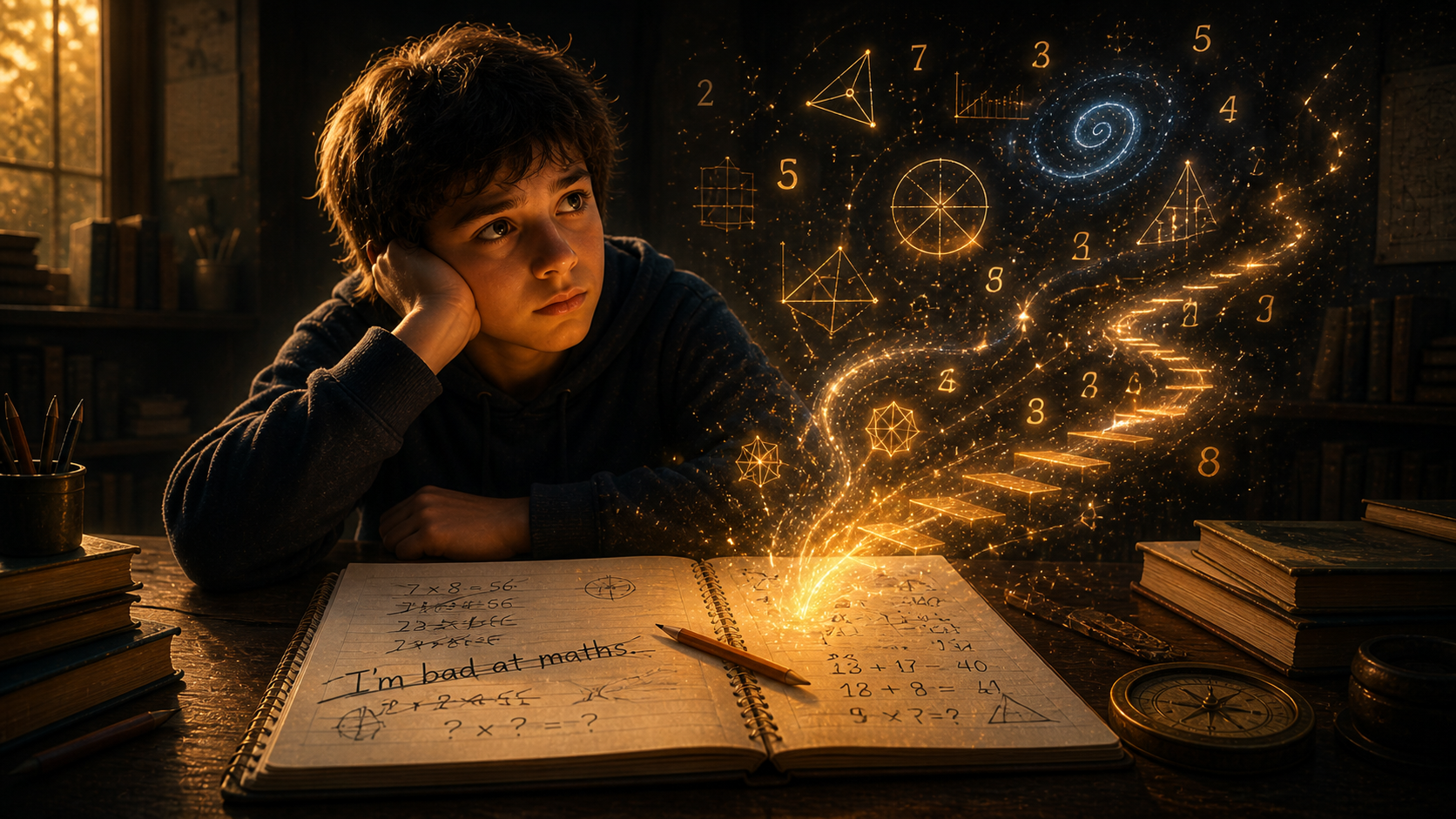
Maths confidence is all-important
Why maths confidence is not just about numbers — it is about learning how to think when things feel difficult.
There is a sentence many people say without thinking.
“I’m bad at maths.”
Adults say it.
Parents say it.
Children say it.
Sometimes even teachers hear it so often that it begins to sound normal.
But it is not a harmless sentence.
Because “I’m bad at maths” is rarely just about maths.
It often means:
“I find this difficult.”
“I was embarrassed once.”
“I fell behind.”
“I do not want to get it wrong.”
“I do not think this belongs to me.”
“I have decided what kind of person I am.”
That is the real problem.
Not the struggle itself. Struggle is part of learning.
The problem is when struggle becomes identity.
Maths confidence matters
Maths has a strange power over confidence.
A child can be thoughtful, creative, curious and capable, but one bad experience with fractions, times tables, algebra or a test can make them feel as though they are simply “not a maths person.”
That label can stick.
And once it sticks, it changes behaviour. Alters attitudes. Reduces self-esteem.
A child who believes they are bad at maths may stop trying quickly.
They may avoid questions.
They may compare themselves to faster classmates.
They may panic when they see numbers.
They may assume confusion means failure.
They may decide there is no point before they have even begun.
That is heartbreaking, because the sentence “I’m bad at maths” often closes a door that was never truly locked.
It just felt locked.
Being stuck is not the same as being bad
One of the most important things we can teach children is this:
Being stuck is not the same as being bad.
Being slow is not the same as being unable.
Getting an answer wrong is not proof that you do not belong.
Maths is full of moments where things do not make sense immediately. That is not a flaw in the learner. It is part of the subject.
A problem asks something of you.
It asks you to pause.
Look again.
Notice what is known.
Notice what is missing.
Break the problem into smaller parts.
Try a route.
Test it.
Change direction if needed.
That process can feel uncomfortable at first. But it is also incredibly valuable.
Because maths does not only teach answers.
It teaches how to think when the answer is not obvious.
The story we tell ourselves
The way we talk about maths matters.
When adults casually say, “I was never any good at maths,” children hear it.
Sometimes they hear permission to give up.
Not because the adult intended that, but because the sentence quietly suggests maths ability is fixed. Some people have it. Some people do not.
But what if we changed the sentence?
Instead of:
“I’m bad at maths.”
We could say:
“I found maths difficult at school.”
“I need more time with this.”
“I have not learned this yet.”
“I can work through it step by step.”
“I used to feel anxious about maths, but I am trying to change that.”
Those sentences leave the door open.
They tell a different story.
And the story matters.
Because children do not only learn maths from what is written on the board. They learn from the emotional atmosphere around it. They learn whether maths is something to fear, rush, avoid, perform, or explore.
Maths is not just calculation
One reason maths anxiety can be so damaging is that maths is often misunderstood.
People think maths means being quick with numbers.
That is part of it, but it is not the whole thing.
Maths is also pattern.
Structure.
Logic.
Measurement.
Reasoning.
Relationship.
Evidence.
Cause and effect.
What follows from what.
In other words, maths teaches us how to approach problems.
That matters far beyond the classroom.
When a child learns to solve a mathematical problem, they are also practising how to slow down and think.
What do I know?
What do I need to find out?
What information matters?
What can I ignore?
What is the first step?
Does this answer make sense?
How can I check?
Those questions are not only useful in maths.
They are useful in life.
Learning to respond, not react
One of the most powerful things maths can teach is the habit of not reacting immediately.
A problem can look frightening at first.
Too many numbers.
Too many words.
Too many symbols.
Too much information.
The emotional reaction might be panic, frustration or avoidance.
But mathematical thinking invites a different response.
Pause.
Read it again.
Separate the parts.
Look for what is known.
Find a starting point.
Work carefully.
Check the result.
That is a deeply valuable life skill.
Because many real-world problems also arrive wrapped in emotion.
Money worries.
Arguments.
Work pressures.
Risk.
Decisions.
Disagreements.
Uncertainty.
If we only react emotionally, we can make situations worse. We may assume, blame, exaggerate, rush or shut down.
But if we can bring structure to the problem, we give ourselves a better chance.
Maths helps build that muscle.
It teaches that a problem does not have to be solved all at once. It can be broken down. It can be examined. It can be approached with care.
That does not remove emotion. Nor should it.
But it gives emotion a framework.
And that can make us calmer.
A calmer way to solve problems
Imagine a child who learns that when something feels difficult, the answer is not to panic or give up.
The answer is to look again.
To ask better questions.
To try one step.
To test what happens.
To change approach if needed.
That child is not just learning maths.
They are learning resilience.
They are learning that confusion can be temporary.
They are learning that problems can be understood.
They are learning that being wrong is not the end of the world.
They are learning that thought can bring order to chaos.
Now imagine more adults with that habit.
Adults who can pause before reacting.
Adults who can separate facts from assumptions.
Adults who can test whether something makes sense.
Adults who can approach disagreement with structure rather than heat.
Adults who can solve problems without immediately turning them into battles.
That may sound ambitious for a subject many people remember as schoolwork.
But I believe maths has that potential.
Not because everyone needs to become a mathematician.
But because everyone benefits from learning how to think more clearly.
A better, safer world
The world does not need more people who can simply pass tests and forget what they learned.
It needs people who can reason.
People who can spot patterns.
People who can question poor evidence.
People who can understand risk.
People who can make fair decisions.
People who can recognise when numbers are being used honestly, and when they are being used to mislead.
Maths plays a part in that.
A society with stronger mathematical confidence is not just better at calculation. It is better equipped to think carefully.
That matters in money.
In health.
In science.
In technology.
In politics.
In business.
In safety.
In everyday decisions.
When people are frightened of numbers, they can be more easily confused by them.
When people feel excluded from maths, they may step back from decisions where mathematical thinking matters.
That is why confidence is not a soft issue.
It is a serious one.
Helping children feel that maths belongs to them is not only about improving grades. It is about giving them tools for life.
The role of parents and teachers
Parents and teachers do not need to pretend maths is always easy.
Children know when something is difficult.
What matters is how we frame the difficulty.
Instead of saying:
“Don’t worry, I was bad at maths too.”
We might say:
“I found this hard as well, but hard does not mean impossible.”
Instead of:
“You either get maths or you don’t.”
We might say:
“Let’s slow it down and find the first step.”
Instead of:
“That’s wrong.”
We might ask:
“Where do you think it started to go off track?”
Small changes in language can make a big difference.
They move maths away from judgement and towards exploration.
They help children see mistakes not as evidence of failure, but as information.
That is one of the most important shifts we can make.
Why this matters in Mathatar
This is one of the reasons I wrote Mathatar.
I did not want to write a story about a child who is brilliant at maths and simply proves how clever she is.
I wanted to write about a child who notices, questions, doubts, struggles and keeps going.
Maya is not powerful because she knows every answer.
She is powerful because she pays attention.
She asks whether things make sense.
She sees patterns.
She spots when reality has slipped.
She learns that confusion is not a dead end.
She learns that thinking carefully can be an act of courage.
That, to me, is the heart of maths confidence.
Not speed.
Not perfection.
Not performance.
Courage.
The courage to look at a problem and say:
“I do not understand this yet.”
And then begin.
Changing the sentence
Maybe the first step is simple.
Maybe we stop saying, “I’m bad at maths.”
Or at least, we stop saying it as though it is a fact carved in stone.
We can replace it with something more honest and more hopeful.
“I used to struggle with maths.”
“I need to build my confidence.”
“I learn better when it is explained differently.”
“I can take this one step at a time.”
“I am still learning.”
That last sentence may be the most important.
Because none of us are finished.
Not children.
Not adults.
Not parents.
Not teachers.
We are all still learning how to think, how to question, how to solve problems and how to make sense of the world.
Maths is part of that.
Not because it makes us emotionless.
But because it helps us bring structure to uncertainty.
It helps us pause.
It helps us reason.
It helps us find the next step.
And sometimes, finding the next step is exactly what confidence is.