From Sales Trainer to Children’s Author: What Storytelling Taught Me
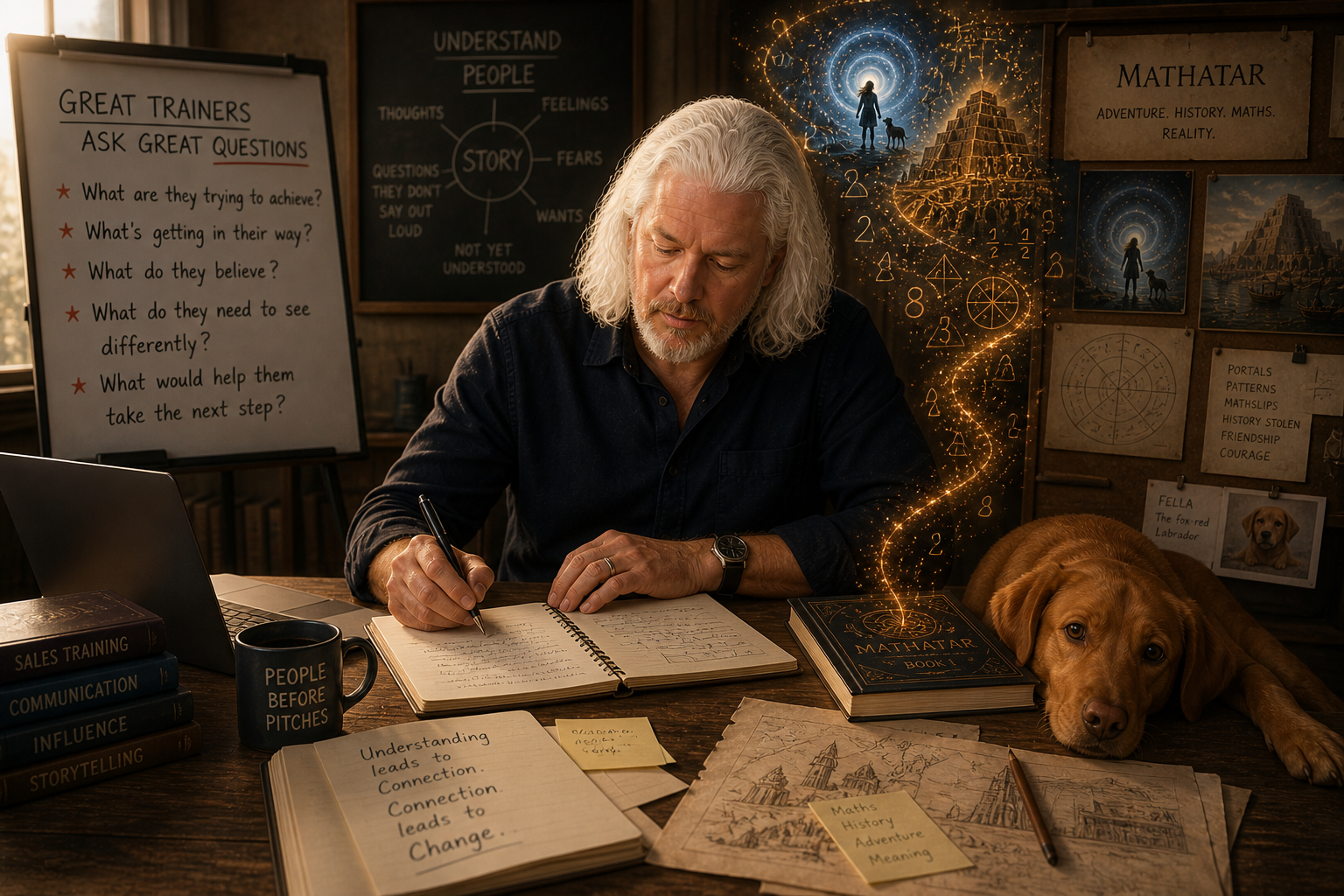
How writing Mathatar felt…
I never expected to write a children’s adventure series about maths.
For most of my working life, I have been in sales, communication, coaching and training. I have stood in front of rooms full of adults talking about confidence, behaviour, listening, questioning, resilience and how to understand what people really want.
So, on the surface, moving from sales training to a story about portals, ancient Ur, mathematical distortions, reality slipping out of place and a fox-red Labrador called Fella might seem like a strange leap.
But the more I wrote Mathatar, the more I realised it was not such a leap after all.
Because underneath the adventure, underneath the history, underneath the fantasy, Mathatar is about something I have cared about for years.
How people think.
How people learn.
How people lose confidence.
And how the right question can change everything.
The story that would not leave me alone
Mathatar was not an idea that arrived suddenly and disappeared.
It had been with me for years.
The original version began back in 2016, when I imagined it as a gamified maths learning world. At the time, I was building a maths training programme and thinking deeply about how to make maths feel less intimidating and more alive.
There were visuals. Videos. Characters. Concepts. Even a playable demo. With Fella front and centre of course.
The business behind that early vision did not survive, but the idea did.
That is the strange thing about some ideas.
They do not always disappear just because the circumstances around them collapse.
Mathatar stayed there.
Quietly. Stubbornly. Waiting.
Then, a few months ago, I woke at around three in the morning with one of those thoughts that does not feel like a normal thought.
It felt more like an instruction.
Mathatar was not waiting to become a game.
It was waiting to become a book.
More than that, it was waiting to become a series.
From that moment, the story seemed to open in front of me.
Writing it felt like channelling
I know this may sound slightly odd, but writing Mathatar often felt less like inventing and more like channelling.
There were times when I sat down to write and felt as though I was simply trying to keep up with the story.
Characters arrived with voices.
Scenes appeared with energy.
Ideas I had carried for years suddenly connected.
Small details from the old game world found new life inside the book.
Maya stepped forward.
Grandad’s workshop became real.
Fella charged into the impossible.
Ancient Ur opened up as the first doorway.
The Null emerged as something far more unsettling than a normal villain. Gone were the less intensive Polygons to be replaced by the much scarier Null.
Of course, writing is also work.
There are chapters to shape, sentences to sharpen, plot problems to solve and doubts to wrestle with. But there were moments when the story seemed to know where it wanted to go before I did.
That was one of the great surprises of writing Mathatar.
I thought I was returning to an old idea.
In truth, it felt as though the idea had been waiting for me to pick up my pen.
Good selling begins with asking the right questions
One of the most important things I taught in sales training is that good selling is not really about talking.
It is about asking the right questions.
Not manipulative questions.
Not clever tricks.
Not scripts designed to push someone into saying yes.
Real questions.
What are you trying to achieve?
What is not working?
What matters most to you?
What have you already tried?
What would a better outcome look like?
What is the real problem underneath the obvious one?
Good salespeople listen before they speak.
They do not assume they know what someone needs. They find out.
That principle has shaped much of my working life.
And when I began writing fiction, I realised storytelling works in a very similar way.
A story begins with questions too.
Who is this character?
What do they want?
What are they afraid of?
What do they believe about themselves?
What happens if they are wrong?
What danger will force them to change?
What question will make the reader turn the page?
The better the questions, the deeper the story becomes.
Maths begins with questions too
This was the real connection I began to see.
Sales training is about questions.
Storytelling is about questions.
And maths, at its heart, is also about questions.
What do I know?
What am I trying to find out?
What information matters?
What can I ignore?
Is there a pattern?
Does this make sense?
Can I prove it?
Can I check it another way?
Too often, maths is presented as if it is only about answers.
Right answer.
Wrong answer.
Tick.
Cross.
Move on.
But the real power of maths is in the thinking.
It teaches us to pause.
To look carefully.
To break a problem down.
To test assumptions.
To follow logic.
To change approach when something is not working.
Those are not just school skills.
They are life skills.
And they are very close to the skills I spent years teaching adults in sales and communication.
Ask better questions.
Listen properly.
Understand the problem before trying to solve it.
Do not panic when the answer is not obvious.
Stay curious.
That is maths.
That is storytelling.
That is life.
What training taught me about confidence
Years of training adults taught me that confidence is often misunderstood.
People think confidence is about being loud, polished or certain.
But real confidence is quieter than that.
It is the willingness to ask a question when you do not understand.
It is the ability to listen without becoming defensive.
It is the courage to try, fail, adjust and try again.
It is being able to say, “I do not know yet,” without feeling ashamed.
That is especially important in maths.
So many children decide far too early that they are “bad at maths”. They carry that sentence like a label. Sometimes they hear it from adults. Sometimes they inherit it from parents who were made to feel the same way at school.
But “I’m bad at maths” is often not the truth.
It is a story someone has started telling themselves.
And stories can be changed.
That idea sits right at the heart of Mathatar.
Maya is not powerful because she knows every answer.
She is powerful because she notices things. She asks questions. She doubts herself, but she keeps going. She learns that confusion is not failure. She learns that a problem can be approached one step at a time.
That is the kind of confidence I care about.
Not cleverness as performance.
Confidence as courage.
A story, not a lesson
One thing I was very clear about from the beginning was that Mathatar had to be a story first.
Children are far too sharp to be fooled by a worksheet wearing a cloak.
I did not want to write a book that stopped every few pages to teach maths. I did not want Maya to feel like a character built to deliver lessons. I did not want the adventure to pause while the reader was told what to learn.
The story had to matter on its own.
Maya had to matter.
Grandad had to matter.
Aya, Fletcher and Fella had to matter.
The danger had to feel real.
The mystery had to pull the reader forward.
But inside that story, maths could become alive.
A number could become a clue.
A decimal could become dangerous.
A pattern could reveal something hidden.
A measurement could protect someone.
A piece of logic could hold reality together.
That is very different from saying, “Maths is useful.”
It shows maths being useful.
It gives it consequence.
It lets the reader feel why it matters.
Communication is about connection
In sales training, I learned that information alone rarely changes people.
You can give someone all the facts.
You can show them the process.
You can explain the method.
You can tell them what they should do.
But until something connects, it often remains just information.
Stories connect.
They help people feel an idea before they analyse it. They create emotion, tension, recognition and meaning.
That is what I hope Mathatar does for maths.
Not by lecturing.
By inviting readers into a world where maths is not cold or lifeless, but strange, ancient, powerful and deeply human.
A world where mathematics is not just something on a page.
It is something people built.
Something history carried.
Something reality depends on.
Something worth protecting.
The question that changed everything
Looking back, I think the move from sales trainer to children’s author makes more sense than I first realised.
For years, I had been helping people ask better questions, understand problems, communicate more clearly and build confidence.
Then Mathatar gave those same ideas a completely different world to live in.
A girl sees reality beginning to slip.
She follows the clues.
She discovers that maths is not simply about getting answers right, but about understanding what holds things together.
And perhaps that is what writing the book taught me most.
Sometimes the story you are meant to tell is already there.
Sometimes it waits for years.
Sometimes it survives failure.
Sometimes it wakes you at three in the morning and refuses to be ignored.
Mathatar did that to me.
It brought together parts of my life I had not fully connected before: sales training, communication, maths, confidence, storytelling, history and the belief that people can change the story they tell themselves.
The question was never simply:
“Can I write a book about maths?”
The better question was:
Can I write a story that helps children feel maths differently?
That question opened the door.
And once it opened, Maya ran through it.
Fella, of course, ran through it first.
God bless that dog.
I miss him every day.