What is a Mathslip?
A small wrongness. A broken pattern. A warning that reality is beginning to slip.
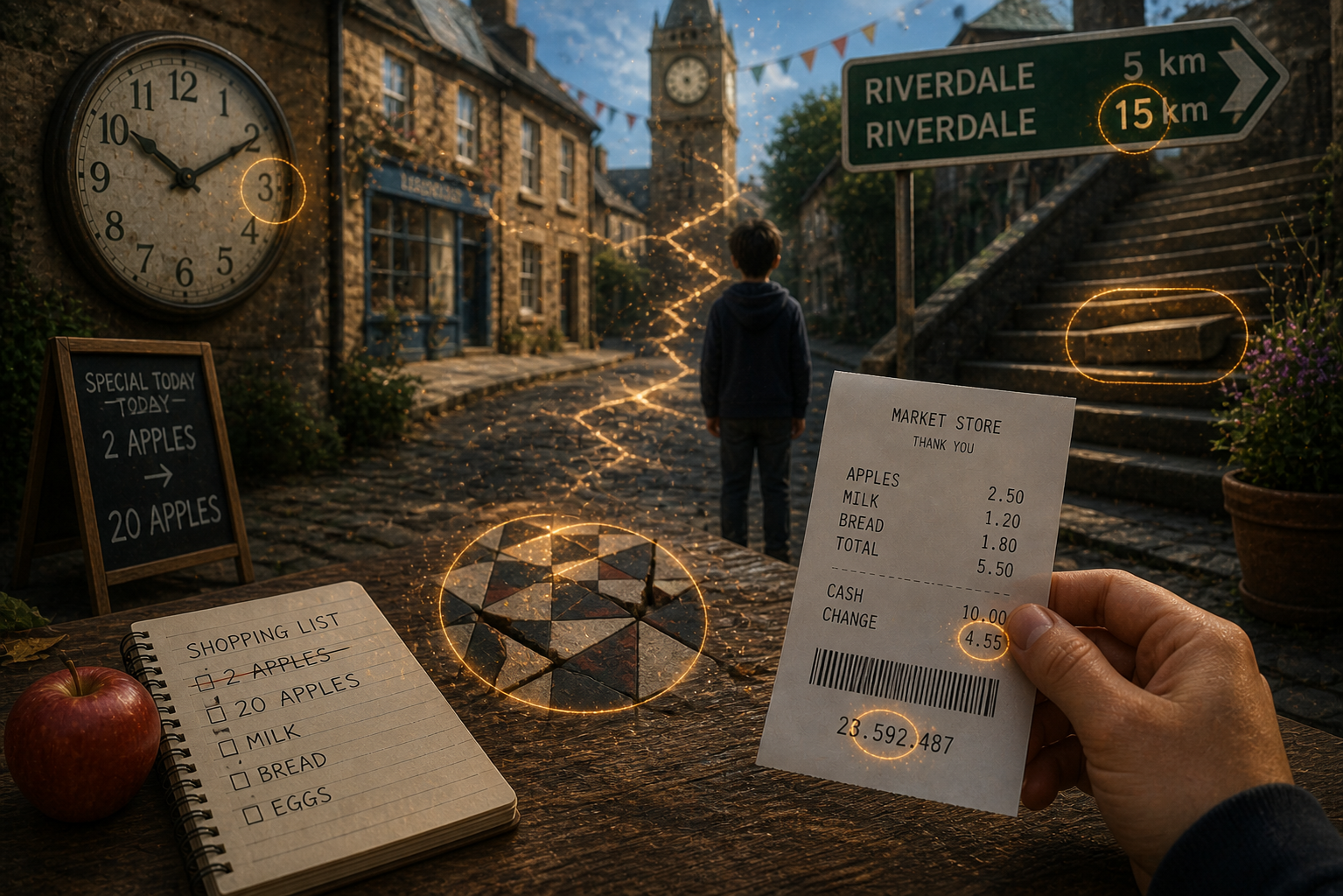
Mathslips… a key company sent of the Mathatar story
A mathslip begins as something small.
So small, in fact, that you might not notice it at first.
A number changes.
A decimal point moves.
A shape does not quite close.
A pattern skips a beat.
A measurement stops making sense.
One moment, everything feels normal.
The next, the world has gone slightly wrong.
That is a mathslip.
In the world of Mathatar, a mathslip is what happens when a piece of mathematics slips out of place. Not enough to destroy reality immediately. Not enough for everyone to panic. Just enough to make the ordinary world feel quietly impossible.
A clock might lose one of its digits.
A shopping list might change from “2 apples” to “20 apples.”
A receipt might become meaningless because its decimal point has shifted.
A staircase might have one step too many.
A road sign might show a distance that cannot be right.
A pattern on a tiled floor might suddenly break.
At first, these things look like mistakes.
But in Mathatar, they are warnings.
When the world forgets how to count
Imagine waking up one morning and noticing that the numbers on your digital clock are wrong.
Not broken.
Not blank.
Just wrong.
Then imagine seeing a price tag where the decimal point has moved, turning something affordable into something ridiculous.
Then a recipe changes.
Then a doorframe looks slightly out of shape.
Then a map shows a distance that cannot possibly fit.
Each thing on its own might be explainable.
A glitch.
A printing error.
A trick of the light.
Someone being careless.
But what if they keep happening?
What if the errors begin to spread?
That is the frightening idea behind a mathslip. It is not just that someone has got a sum wrong. It is that the rules beneath the sum are starting to weaken.
Because if numbers cannot be trusted, what else begins to fail?
Prices.
Time.
Distance.
Medicine.
Buildings.
Music.
Maps.
Memory.
Meaning.
Maths is so woven into ordinary life that we often stop noticing it. A mathslip makes us notice it again.
Usually because something has gone wrong.
Not just a mistake
A normal mistake is human.
We miscount.
We forget a zero.
We read a number too quickly.
We write something down badly.
A mathslip is different.
A mathslip is not someone making an error in the world.
It is the world making an error in itself.
That is why Maya, the main character in Mathatar, finds them so disturbing. At first, the slips are small enough to doubt. She wonders whether she has imagined them. She wonders whether she is tired, confused, or simply noticing things that were always there.
But the more they happen, the harder they are to ignore.
The wrongness has a pattern.
And that matters.
Because one strange event might be random.
Two might be coincidence.
But a pattern means something is happening.
Why decimals matter
One of the reasons I love the idea of a mathslip is that tiny mathematical changes can have enormous consequences.
Move a decimal point and £1.50 becomes £15.00.
Mistake metres for centimetres and a measurement changes completely.
Put a zero in the wrong place and a small number becomes a huge one.
Change the angle of a support beam and a building may not stand as it should.
Misread a dose and medicine becomes dangerous.
Maths can feel abstract when it sits on a page, but in the real world it has weight. It affects decisions, safety, fairness, design, money, time and trust.
That is why mathslips are such a powerful idea for a story.
They turn small errors into clues.
They take the things children learn in classrooms — place value, decimals, patterns, shapes, measurement, logic — and ask what would happen if those things started to fail in real life.
Not in a worksheet.
In reality.
What if someone started stealing maths?
Of course, in Mathatar, mathslips are not happening by accident.
They are signs of something much bigger.
Someone — or something — is interfering with mathematics itself.
Not just changing answers.
Not just causing confusion.
Stealing maths from history.
That is where the idea becomes much more dangerous.
Because maths did not appear all at once. It grew through human history. People learned to count, record, measure, compare, trade, build, predict and prove things over thousands of years.
Each discovery became part of the structure we now depend on.
So what would happen if those discoveries were removed?
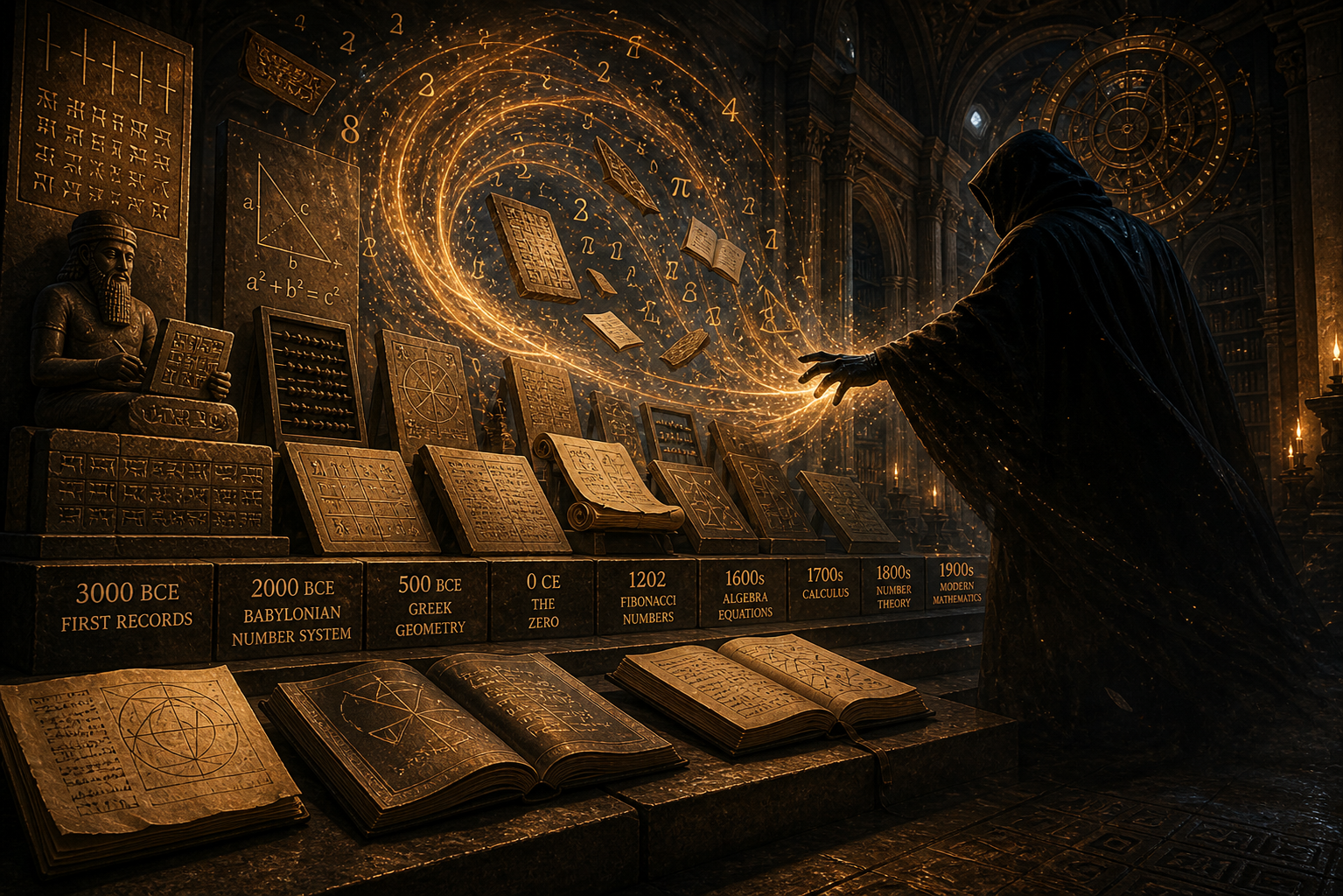
The Archivist at work…
What if counting became unstable?
What if measurement stopped developing?
What if patterns were no longer understood?
What if the ideas that shaped civilisation were quietly taken away?
At first, perhaps, the world would not collapse.
It would slip.
A number here.
A shape there.
A broken pattern.
A failed measurement.
A piece of logic that no longer holds.
That is the beginning of the danger.
That is a mathslip.
Why Maya notices them
Maya is not special because she is perfect at maths.
She is not the chosen one because she can instantly solve every problem.
That would be too easy.
Maya notices mathslips because she pays attention.
She sees the tiny wrongness that other people explain away. She asks questions when things do not fit. She trusts her instincts when the world tells her to ignore what she has seen.
That is important.
Because Mathatar is not about being the fastest at maths.
It is about curiosity.
It is about noticing patterns.
It is about asking, “Does this make sense?”
That question is one of the most powerful questions in mathematics, and one of the most powerful questions in life.
A story idea with a real-world heart
Mathslips are fictional, of course.
Receipts do not usually rewrite themselves. Digital clocks do not normally lose digits because reality is weakening. Tiled floors do not break their patterns because an ancient mathematical principle has been stolen.
But the idea behind mathslips is rooted in something real.
Maths is everywhere.
It is in time, money, maps, music, buildings, recipes, games, phones, journeys, calendars, medicine, sport, weather, design and stories.
Most of the time, we only notice it when something goes wrong.
A wrong price.
A wrong turning.
A wrong measurement.
A wrong calculation.
Mathatar simply takes that feeling and turns it into an adventure.
It asks: what if those little errors were not mistakes?
What if they were clues?
What if they were the first signs that reality itself was beginning to lose its grip?
The fun of a mathslip
One of the things I enjoy most about mathslips is that they can be funny, strange, unsettling or dangerous depending on where they happen.
A cake recipe that suddenly asks for 300 eggs is funny.
A lift that says it is going to floor 8 when the building only has 5 floors is unsettling.
A bridge built from slipping measurements is dangerous.
A map that changes distance while you are using it is terrifying.
That range gives Mathatar a lot of room to play.
Mathslips can create humour.
They can create mystery.
They can create danger.
They can reveal how much of the world depends on ideas we often take for granted.
And for young readers, they offer a simple invitation:
Look around.
Where is the maths hiding?
What would happen if it slipped?
So, what is a mathslip?
A mathslip is a small mathematical wrongness in the world.
A sign that a number, shape, pattern, measurement or piece of logic has shifted out of place.
At first, it may look like a mistake.
But in Mathatar, it is something far more serious.
It is a warning that the hidden structure of reality is being damaged.
It is the first crack in the wall.
And once Maya starts seeing the cracks, she cannot unsee them.
Because someone is stealing maths from history.
And if they succeed, the world will not simply get its sums wrong.
It may forget how to hold itself together.