The ancient civilisation we don’t talk about
The City Time Forgot: Why Ur Deserves a Place Beside the Pyramids
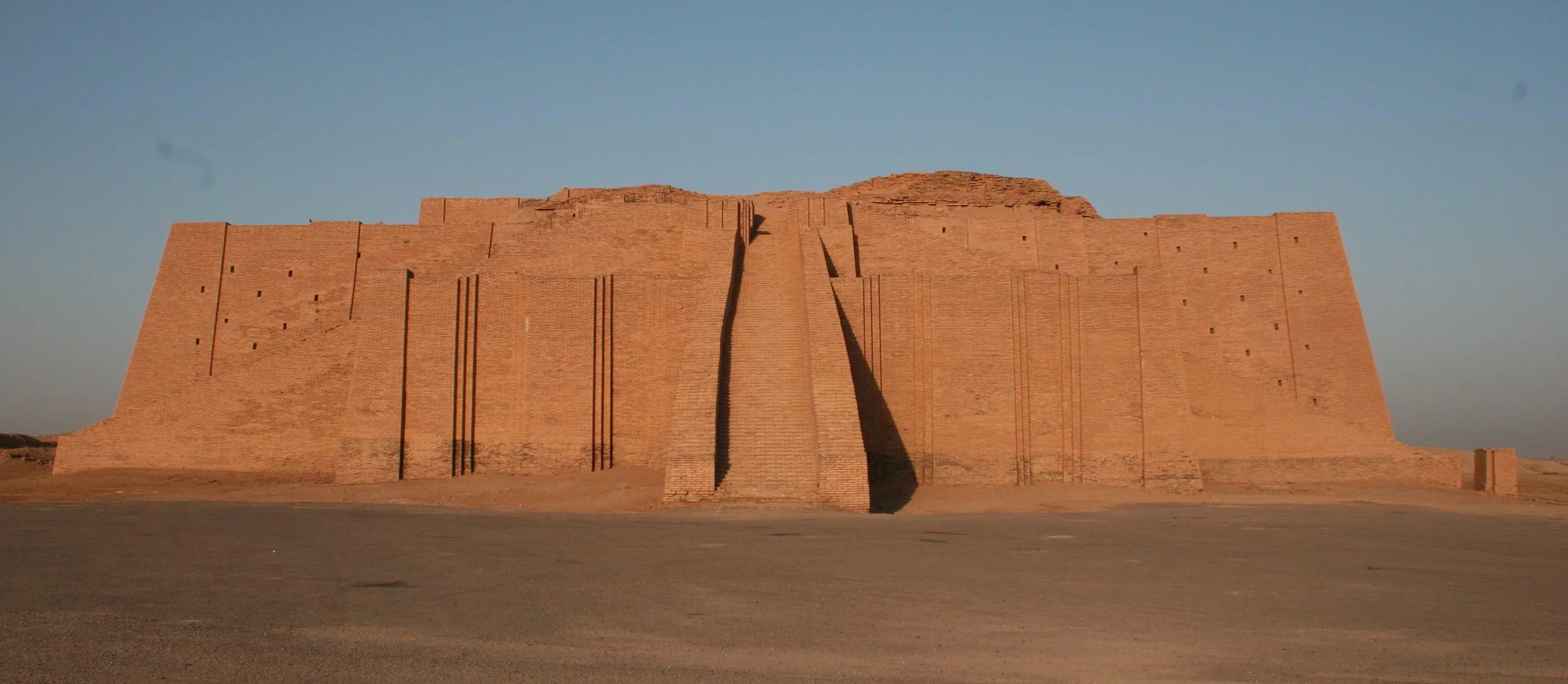
The impressive Ziggurat of Ur
Ask someone to picture ancient Egypt and the images arrive instantly: the pyramids, Tutenkhamun’s golden sarcophagi, camels silhouetted against the Giza plateau, the hush of a tomb sealed for three thousand years. Egypt has spent over a century building that picture into the global psyche, and it worked. Egypt’s economy is reliant on tourism, ten million visitors a year, most of them chasing pharaohs. Ask the same person to picture Ur, and you will likely get silence. Yet Ur is, by some distance a more important chapter in the human story. It and its sister city, Uruk, may be the first true cities on Earth, Sumer, in Mesopotamia, being the place where there first markings on seals to identify commodities, morphed into writing with cuneiform being the first and that matured into literature and law. Sumer, the wellspring of a mathematical system so effective that we still tell time by it. It never made the leap into public consciousness that Egypt did.
Mesopotamia, the word means between the two rivers, and Ur sit in southern Iraq's Dhi Qar Governorate, about sixteen kilometres southwest of the modern city of Nasiriyah, on ground that was once a bustling port on the Euphrates before the river shifted its course and left the ruins stranded inland. People had settled the site since before 3800 BCE, and by the 2600BCE it was a recognizable city-state with priest-kings and ruling councils. It had a golden age came under Ur-Nammu, who founded the Third Dynasty of Ur around 2047 BCE. Ur-Nammu drained marshes, dug irrigation canals, built the incredible, towering ziggurat dedicated to the moon god Nanna, and issued a written legal code three centuries before Hammurabi's more famous one. His son Shulgi turned the city into the capital of a genuinely efficient bureaucratic empire, with standardized weights, measures, and a civil service that kept meticulous records on clay tablet. The Great Ziggurat of Ur still stands today, its lower terraces reconstructed, making it one of the best-preserved monuments anywhere in Mesopotamia, a structure every bit as photogenic as anything on the Nile.
What Ur offered the world beneath its temples was arguably more startling than the temples themselves. When the British archaeologist Leonard Woolley excavated the site between 1922 and 1934, he uncovered a royal cemetery holding roughly 1,850 burials, sixteen or seventeen of them lavish royal tombs dating to around 2600 BC. The unlooted tomb of Queen Puabi alone yielded an extraordinary trove: gold headdresses, lapis lazuli and carnelian jewelry imported from as far as Afghanistan and the Indus Valley, elaborately inlaid lyres shaped like bulls, and the Standard of Ur, a small wooden box inlaid with shell and stone depicting scenes of peace and war that remain among the most reproduced images of the ancient Near East. In terms of craftsmanship and sheer material richness, this find rivals what Howard Carter pulled from Tutankhamun's tomb just a few years earlier in Egypt. Tutankhamun became a household name. Puabi did not.
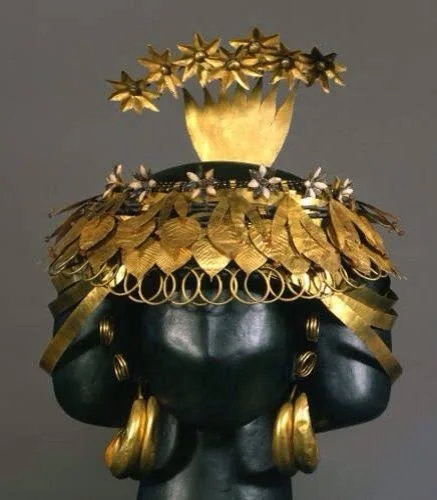
Queen Pulabi’s golden Head Dress
Howard Carter’s skilful management and building of hysteria around the finds captured the public imagination whereas Leonard Wooley’s careful and meticulous dig that was more professional and careful by far, just didn’t.
I think geography also helped, it was much easier to get to Egypt than central/ southern Iraq.
But, make no mistake, of the two, Ancient Ur is actually more important than Ancient Egypt.
The mathematics is where Ur's legacy becomes almost invisible in plain sight. Sumerian scribes developed a sexagesimal, or base-60, numbering system, and refined it into genuine place-value notation centuries before anyone else managed the trick. That single innovation is why a clock face has 60 minutes and 60 seconds, and why a circle has 360 degrees, conventions that have quietly survived roughly four thousand years without most people ever tracing them back to their source. Without it, our world wouldn’t operate at all.
Clay tablets from the world these scribes recorded show squares, cubes, and reciprocal tables extending, letting scribes turn division into multiplication by lookup quickly and easily. Later Old Babylonian mathematicians, working within the intellectual tradition Ur helped establish, solved linear and quadratic equations using methods equivalent to the modern quadratic formula, and produced tablets that encode Pythagorean triples more than a thousand years before Pythagoras was born. This was not primitive counting. It was a functioning, tested, transmissible mathematical technology, developed to manage grain stores, canal networks, and a sprawling bureaucracy, and it fed directly into the mathematics of Babylon, Greece, and eventually us. If any ancient site deserves to be a pilgrimage stop for anyone who loves numbers, it is this one.
So why has the West largely left Ur off the map? Part of the answer is simply time and infrastructure. Egyptian tourism has been an organized industry since the nineteenth century, with railways, hotels, guidebooks, and a century of films and novels cementing pyramids and mummies as shorthand for "ancient wonder."
Death On The Nile by Agatha Christie? Films, TV series, plays and books abound. Yet her book Murder In Mesopotamia? Crickets and silence. One episode of Poirot references it. Nile< two major films, several TV adaptations, plays and the like.
Iraq had no equivalent runway. Decades of war, international sanctions through the 1990s, the 2003 invasion and its long aftermath, and the rise of ISIS in the 2010s made the country a byword for danger rather than heritage, and understandably kept travel advisories, insurers, and ordinary tourists away even as the monuments themselves survived largely intact. Even today, it’s not advised to visit.
Ur itself sat for years beside Tallil, a military airbase, which limited casual access even after security improved. Meanwhile the story Mesopotamia has to tell is a harder sell for popular culture: there is no Sumerian equivalent of the mummy's curse, no single visual as instantly recognizable as a pyramid, apart from the Ziggurat, and cuneiform tablets simply photograph less dramatically than hieroglyphs, gold death masks, even when what they contain is more consequential.
I recently visited the Egyptian monuments as part of my research into Mathatar, as book 2 takes place in ancient Egypt. I haven’t been able to visit Ur, sadly. But that doesn’t mean I won’t. I hope that the future of the development of the site continues and that more people can connect with this amazing period of our lives.

Maya about to visit Ur
The positive is that it may finally be changing. Iraqi authorities have been developing an "Ur Tourist City" around the site, anchored by the Ur World Museum in Dhi Qar, now reportedly more than ninety percent complete, which is planned to display over ten thousand artifacts across twenty-eight halls. A new international airport serving Nasiriyah is intended to open the region to visitors who would previously have had to route through Baghdad or Basra. None of this guarantees Ur will suddenly rival Cairo in the tour-operator brochures, but it suggests the raw material for that shift — genuine monuments, genuine treasures, and a genuinely foundational story — is no longer going to waste.
Ur does not need Egypt's marketing to be significant. It needs the rest of us to notice that the numbers on our clocks, the degrees on our compasses, and the very idea of a city with laws and a bureaucracy all trace back to a stretch of riverbank in southern Iraq that most people have never heard of. Giza earned its fame. Ur simply hasn't been given the chance to earn its own.
Ur (and Uruk) gave humanity the essential ingredients for human civilisation and it’s a shame that it’s so lost on so many people.